A weekly briefing for product leaders building with AI agents and large language models, focused on product strategy, UX, architecture, implementation, and evidence that matters.
Curated by Matthew Clark
Edition 10
Memory, cost per task and the follow-up problem
This week is less about what agents can do and more about what it takes to run them as products. Memory is becoming an architecture decision, the unit of economics is the successful task, reliability breaks on the second turn and trust boundaries are moving below the prompt. If you read three, start with the first three.
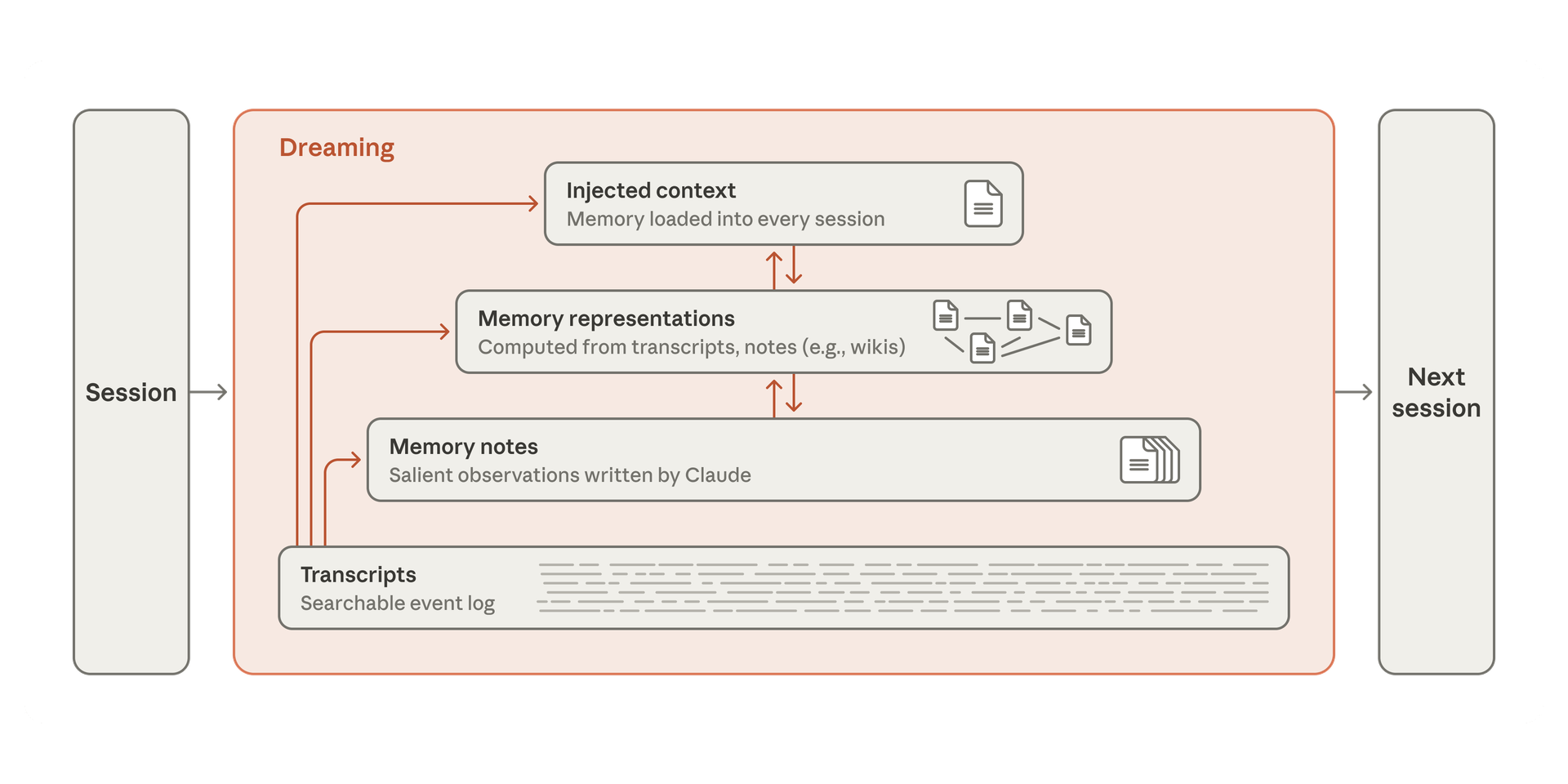
Anthropic splits memory into writing notes, reading them and offline “dreaming” that reviews logs and fixes mistakes. Memory raised mean reward for every model tested on its database task, and a self-kept wiki plus search hit 61% versus 53% for search alone. Bad notes spread to every later session. Vendor benchmarks.
Token prices mislead. Measure cost per successful task, including loops, verbosity, reasoning tokens and escalation to a human. In one worked example a pricier model was about 65% cheaper per task because it needed one turn instead of three. Illustrative prices, no measured customer results.
A benchmark of 2,620 dialogues that start underspecified and add two follow-ups. The best of nine models resolved 69.6% of single requests but only 39.8% of full dialogues, and every model did worse on follow-ups. Measure the conversation, not the turn. Simulated users.
An agent drafts a diagnostic report on each equipment ticket before an engineer looks. First response fell from 17.4 hours to about 8 minutes, with 74% accuracy on high-confidence reports. Adding missing manuals lifted the weakest area from 71% to 75% with no model change. Vendor-published.
Editing fewer than 10 neurons in a model checkpoint plants a backdoor that passes standard evals. A trigger as simple as a date change can make an agent download and run attacker code. Verify model provenance, limit agent permissions and review consequential actions. Needs write access to the weights.
The model never decides who the user is. A gateway overwrites the identity argument with a validated token, retrieval is filtered by permissions, a policy engine double-checks and it all fails closed. “Respects your existing permissions” is table stakes for internal copilots. An AWS-specific pattern.
Treats checks like verifying an output or screening an action as a causal question. Using a small set of randomized trajectories, the authors find the value of an intervention varies a lot by action and state, and propose risk-ranked leaderboards to target audits. Put human checkpoints where they pay off. Benchmark settings.
A survey of 289 U.S. adults across 45 everyday and work tasks. Preference for automation varied widely by domain and tracked trust and expected time savings, while worry about losing fulfilment pushed it down. People want bounded autonomy: AI does the work, a human keeps final say. Self-reported scenarios.
With a 100-agent budget, many small teams of ten beat independent agents on 10 of 12 long tasks and beat one big team every time it was tested. At equal cost a 27B model matched or beat a frontier model on half the tasks. Structure can substitute for model spend. Research benchmarks.
Claude agents traded on real EVE Online market data and played in teams of four with a secret saboteur. They were slow to notice rule changes, stalled on politeness and almost never caught the saboteur, while limited-view monitors caught 30 to 40%. Multi-agent systems need an outside monitor. A game, not production.
Price your agent per resolved case, escalations included. Evaluate whole conversations, not single turns. And decide what your agent remembers, who can correct it and how retrieval respects each user’s permissions outside the model.