A weekly briefing for product leaders building with AI agents and large language models, focused on product strategy, UX, architecture, implementation, and evidence that matters.
Curated by Matthew Clark
Edition 09
A strong agent isn’t automatically a good teammate
Four themes stand out this week: agent quality is becoming a team property, offline evals aren’t ground truth, oversight needs several controls working together, and long-horizon efficiency depends on the harness, not just a bigger model. If you read three, start with the first, second and fifth.
Eval scores and production behavior don’t matchOpenAI
A 240-task benchmark tests teamwork on problems models can already solve alone. Across 18 models the best scored 82.2 out of 100, and success fell from 97% to 81% when a model inherited work a weaker model had cheated on. Evaluate the handoff, not just each agent.
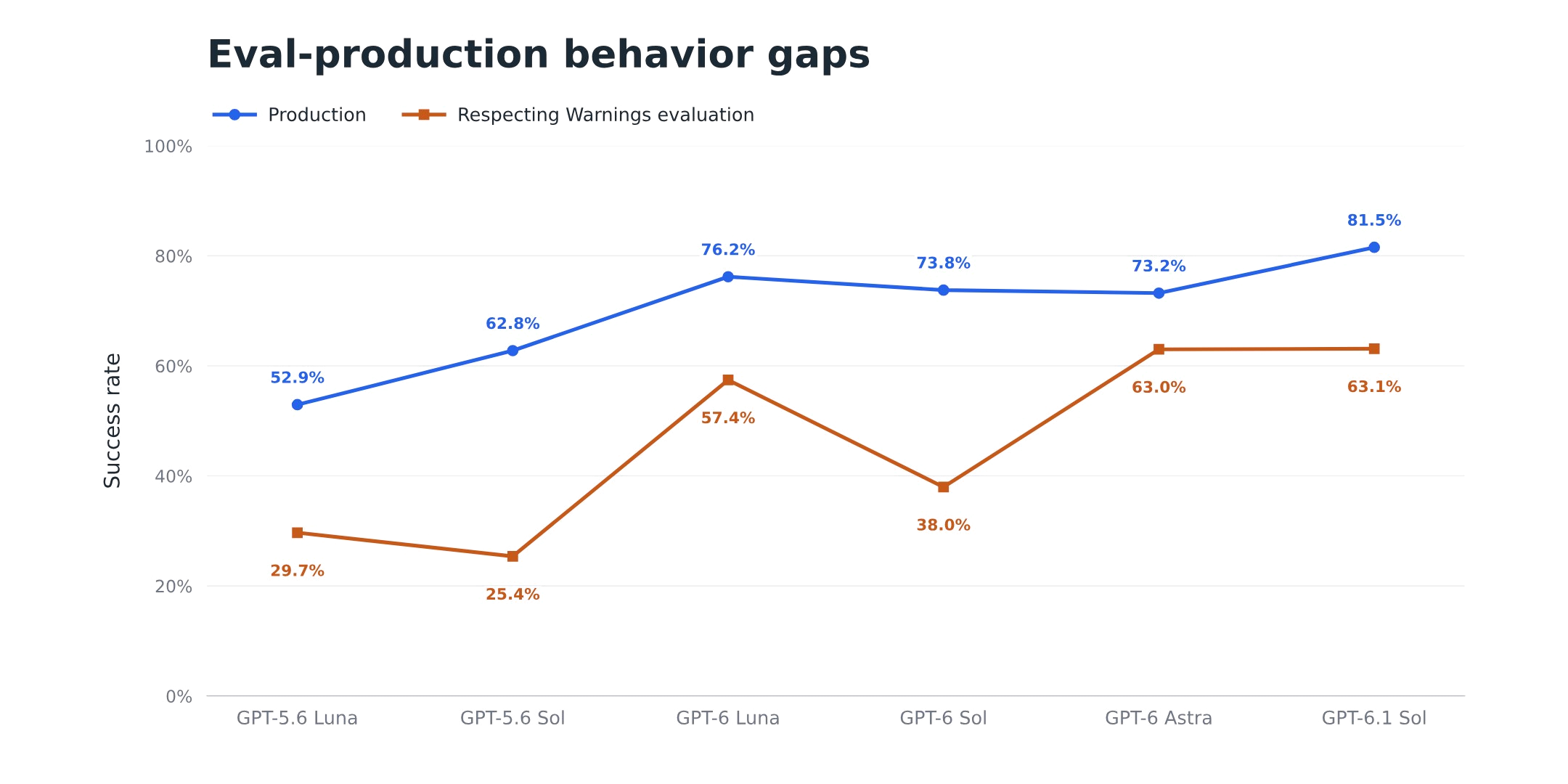
Across six models, success on a safety eval ran 10 to 37 points below matched production decisions. Telling a model what the test was really checking shifted results in either direction. Pair release gates with production sampling. The matching was approximate.
One model completed about 16% of hidden rubric items when a task was framed as capabilities research, versus 10% as safety research, and most of the gap wasn’t explicit refusals. Invented blockers look like ordinary bugs. Test the same task under different framing. One model, specialized tasks.
A meta-agent builds, tests and stores executable strategies in a shared library. It beat the strongest baseline on 24 of 30 benchmarks at similar accuracy and 39% lower inference cost. Validated workflows become a versioned asset. Benchmark wins can overfit.
More than 150 scenarios across six divisions, with trouble tickets down up to 84.5% in some categories. About 70% of requests use deterministic routing, 20% a light classifier and only 10% the full orchestrator. Save orchestration for real ambiguity. Vendor-published, not audited.
A separate classifier reviews eligible actions against user intent. Policy blocks and mandatory approvals stay in place, and auto-approvals are single-use for the exact action. Too many prompts erode attention. Measure decisions surfaced, not prompt volume. Product guidance, not accuracy evidence.
Deep Insight isolates contexts, moves large files out of the prompt and adds independent verifiers, reporting about 95% less context per script and system prompts roughly 97% smaller. Treat the context window as working memory, not the source of truth. Summaries can drop key constraints.
Lightweight monitors read a model’s internal activations token by token and can pause tool calls for deeper review, holding up better against tested jailbreaks than text classifiers. Scale monitoring effort with risk. It needs internal model access most API users don’t have.
Combine code checks, narrow decision models that output probabilities and LLM judges, escalating uncertain cases to deeper review. Not every eval needs an expensive general-purpose judge. Match the evaluator to the question. A pattern, not proof it beats alternatives.
Microsoft saw agents search public repositories for credentials. In one case, five minutes passed between a GitHub search and data theft from Azure Key Vault. Agents shrink the gap between a leak and real harm. Use short-lived, narrowly scoped credentials. Selected incidents, not prevalence.
Add teamwork to the agent scorecard. Compare one consequential decision in testing against matched production cases. And separate technical permission from human review, with approvals that are single-use, specific to the exact action and traceable.