Context
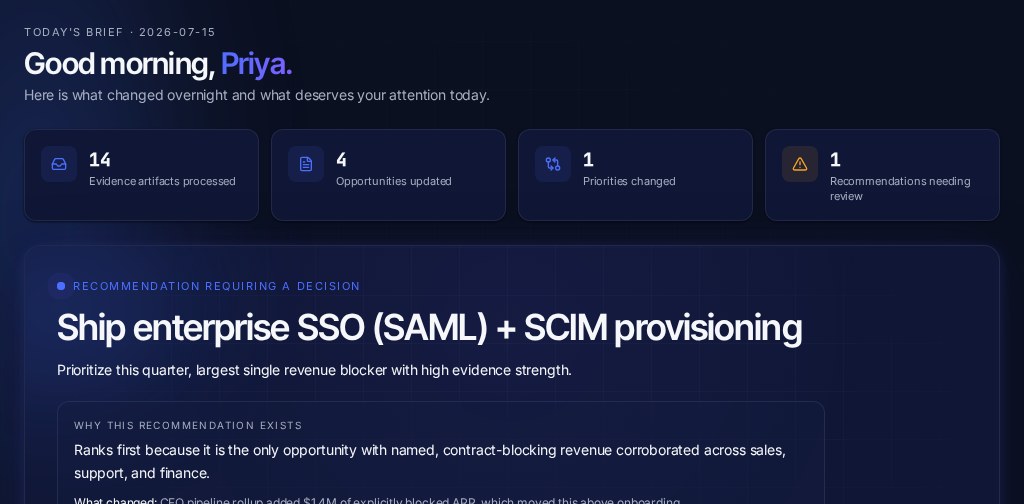
Product teams rarely struggle because they have too few ideas. They struggle because they have too many. Feature requests arrive from customers, executives, sales, support, engineering, research, and competitive analysis. Each one sounds reasonable in isolation, but the team still has to answer a harder question: what should we build next, and why? Traditional frameworks help organize the decision, but they often flatten complex product judgment into a score. A feature gets a 7.4, another gets an 8.1, the roadmap changes, and the reasoning behind the decision is what gets lost. I created Juno as my Product School AI Product Management capstone to explore how AI, especially agentic AI, could make prioritization more intelligent, explainable, and context-aware. The core idea: Juno doesn't just tell you what to prioritize. It helps explain why.
Problem
Prioritization is one of the most important responsibilities in product management, but the process is often fragmented. Teams pull information from customer feedback, product analytics, strategic goals, leadership requests, engineering estimates, revenue opportunities, research, support tickets, and competitive intelligence. Then the PM is expected to synthesize all of it into a coherent recommendation. In practice, much of that reasoning lives in spreadsheets, tickets, meetings, documents, or simply inside the product manager's head.
- Prioritization becomes subjective: a precise-looking score can create the appearance of objectivity without capturing the assumptions underneath it.
- Context gets lost: a feature may matter because it supports a strategic objective, addresses a severe customer problem, enables another initiative, or reduces operational risk, and a single score rarely communicates all of that.
- Stakeholders see the decision, not the reasoning: when leadership asks why one initiative moved ahead of another, teams reconstruct the logic weeks later.
- Inputs constantly change: customer demand, engineering estimates, and business priorities shift, so a static prioritization exercise becomes outdated quickly.
My role
Lead Product Manager, UX Strategist, and AI Product Architect on my Product School AI Product Management capstone.
How Juno works
- 1.
From scoring to decision intelligence
Traditional frameworks remain useful, but they are only one input. Juno evaluates strategic alignment, customer impact, confidence in the evidence, engineering complexity, dependencies, risk, urgency, revenue potential, operational impact, and learning value together, then produces a recommendation with its reasoning attached. The output is not 'Feature A: 8.3'. It is: Feature A should move ahead because it strongly supports the current strategic objective, addresses a validated customer pain point, and carries relatively low implementation risk, and the recommendation depends on the current engineering estimate, so it should be reconsidered if scope increases significantly.
- 2.
Designing the AI experience around explainability
I didn't want Juno to become a black box that generates priorities and expects teams to trust them. That is automation without transparency, exactly the problem product managers should avoid. The guiding principle: AI should strengthen product judgment, not obscure it. So the experience emphasizes explainability: which evidence influenced the recommendation, which assumptions were made, how strategic goals affected the ranking, where confidence is high or low, and what new information could change the result.
- 3.
Agentic architecture: specialized reasoning, not one big prompt
Rather than relying on a single model prompt to make the entire decision, Juno was conceived as a system of specialized reasoning responsibilities. A Customer Insight Agent synthesizes research, feedback, support data, and customer pain points. A Strategy Agent evaluates alignment with company objectives and product strategy. A Business Impact Agent examines revenue, cost reduction, retention, and operational impact. A Technical Feasibility Agent considers engineering complexity, dependencies, and implementation risk. A Prioritization Agent combines those perspectives into an overall recommendation. A Challenge Agent actively looks for weak assumptions, contradictory evidence, or reasons the recommendation may be wrong. The purpose is not autonomous product management; it is a structured AI reasoning system that examines a decision from multiple perspectives before presenting it to a human product leader.
- 4.
Keeping the human in the loop
Juno can analyze, challenge, and recommend. Juno does not own the roadmap. The product manager can adjust assumptions, override recommendations, add context, or reject the AI's conclusion entirely, and when that happens, the decision and its rationale remain visible. That creates a useful audit trail: instead of asking six months later why something was built, the team can see the evidence, recommendation, assumptions, and human decision that shaped the roadmap at the time.
- 5.
UX principles the interface was built on
Explain before you score: a ranking without context creates false certainty. Make assumptions visible: every prioritization model contains them, so surface rather than hide them. Encourage challenge: strong decisions improve when teams actively look for reasons they might be wrong, so Juno surfaces conflicting evidence and uncertainty instead of reinforcing the initial recommendation. Preserve decision history: prioritization changes over time, and that history is valuable product knowledge. Keep the human accountable: AI recommendations support product leadership, they don't replace it.
- 6.
The larger bet: an intelligence layer for product decisions
The vision extends beyond prioritization. Over time the system could connect product strategy, customer research, business outcomes, engineering constraints, and roadmap decisions into a continuously evolving decision model, maintaining the relationships between strategy, evidence, opportunity, priority, decision, and outcome. If a highly ranked initiative fails, the organization can examine which assumptions were wrong. If an unexpected initiative succeeds, the system can identify what signals were underestimated. Prioritization then becomes not only a planning process, but a learning system.
Results
What the capstone produced
- Decision intelligence model
- A prioritization approach that weighs strategy, customer impact, evidence confidence, complexity, dependencies, risk, urgency, revenue, operations, and learning value together
- Explainable recommendations
- Output that carries its evidence, assumptions, and uncertainty instead of a bare score
- Agentic architecture
- Six specialized reasoning roles, including a Challenge Agent that argues against the recommendation
- Human-in-the-loop workflow
- PMs adjust assumptions, override recommendations, or reject the AI's conclusion, with the rationale preserved
- Decision history
- An audit trail connecting evidence, recommendation, assumptions, and the human decision
The shift it demonstrates
- Backlog management → Decision intelligence
- Prioritization as an evolving decision process, not a one-time scoring exercise
- Scores → Explainable recommendations
- Reasoning becomes part of the product artifact
- Static prioritization → Continuous evaluation
- Recommendations update as demand, estimates, and priorities change
- AI answers → Human decisions, supported by AI
- AI performs the synthesis; the PM retains the decision
What I learned
- The most valuable AI products may not replace decisions. They may improve the quality of the decisions humans make. Generative AI makes it easy to produce answers. Product leaders need something more valuable: context, reasoning, evidence, uncertainty, and accountability.
- A precise score can be a false comfort. Frameworks like RICE and weighted scoring are useful inputs, but the inputs themselves are often subjective. A number that looks objective can hide the assumptions underneath it, so Juno surfaces those assumptions instead of burying them.
- Design for disagreement. A recommendation is only trustworthy if the person receiving it can argue with it. Building in the ability to adjust assumptions, override, or reject the AI's conclusion is what makes the output usable in front of stakeholders.
- An AI feature becomes an AI product system once you answer the hard questions. What information the AI needs, how different forms of evidence should be evaluated, where agents specialize, how recommendations are explained, where human review occurs, how uncertainty is communicated, and what happens when the human disagrees. Those questions moved this from a feature concept to a product system.
- The best roadmap isn't the one with the most sophisticated scoring model. It's the one where the team understands why every priority earned its place.